The publication date is November 4. The prices in the charts run through the November 3 close, because that is the last session in the file. Neither cutoff is a publication date. I am not describing a note that existed in August or September.
One rule dates both moves. It is applied after the fact. The ten sessions it uses as follow-through did not exist on the cutoff date, so the rule was not a finished test on that date.
The file is the Yahoo Finance chart series retrieved at 13:39 UTC on November 4, 2026, range=2y, interval=1d, for ABCL and TWST. From November 4, 2024 through November 3, 2026 the adjusted close equals the close on every session, and the payload lists no split and no dividend. The daily rows are ABCL and TWST. Nasdaq's historical quote endpoint returned no rows for the dates I checked the same day. Stooq returned a browser check. The prices below are this file, timestamped here, not an exchange print I could re-pull from a second vendor.
Under that rule, AbCellera's latest sustained 2026 signal is August 10. Twist's only sustained 2026 signal is September 17. The same rule also marks AbCellera on January 6, a close of $3.90 against a December 12, 2025 high of $3.86, on 1.97 times volume. That one passed the ten-session test. By March 31 the close was $3.49. A ten-session pass is not a description of the rest of the year.
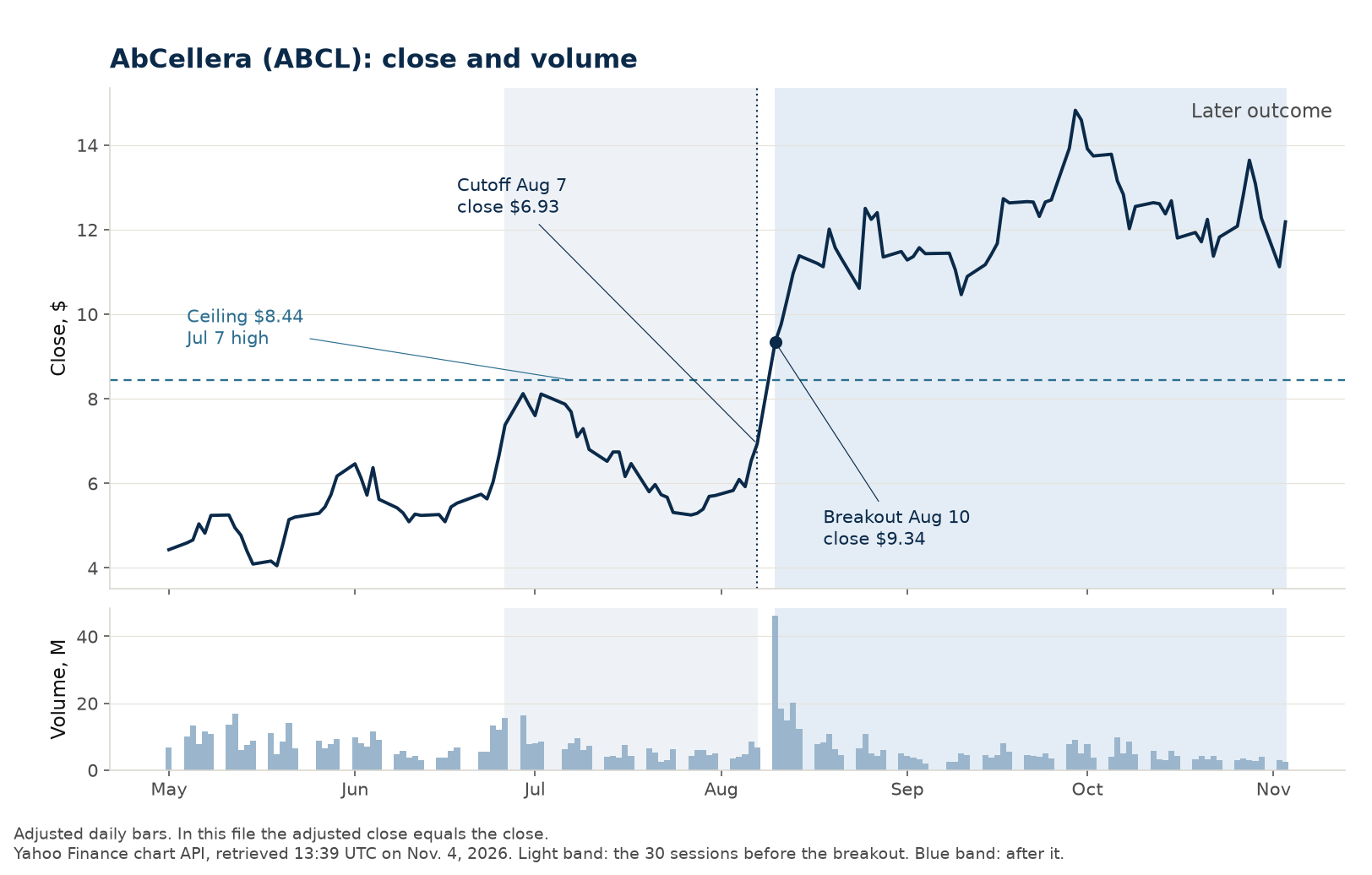
AbCellera, as of the August 7 close
August 7, 2026 was a Friday. The close in this file is $6.93. The high was $6.99 and the low was $6.35, on 6.82 million shares. The simple average of the last 50 closes, ending that day, is $6.19. The 200-session average is $4.49. The close was above both averages and under the base ceiling of $8.44, which is the July 7 high. That high was 24 sessions earlier. The July 28 low was $4.98. The stock had already fallen from the late-June push, which closed at $8.12 on June 29, and it had not taken that high back.
The August 5 earnings release, furnished with an 8-K accepted by EDGAR at 4:18 p.m. Eastern, was already public. So was the quarterly report filed the same day. So was a short scheduling release on August 7 itself.
| Item on the August 7 record | Figure | Where it sits |
|---|---|---|
| August 7 close, this file | $6.93 | Last print before August 10 |
| Common shares, August 3 | 306,611,466 | 10-Q cover |
| Equity value, $6.93 times that count | $2,124.8 million | Arithmetic, not a filing |
| Cash, equivalents, marketable securities, June 30 | $540.1 million | 10-Q liquidity section |
| Current restricted cash, June 30 | $25.0 million | Balance sheet |
| Cash balances plus marketable securities, company wording | Over $565 million | August 5 release |
| Government funding still available to claim | $110.0 million (CAD $156.1 million) | 10-Q, not cash |
| Q2 revenue | $4.1 million | Versus $17.1 million in Q2 2025 |
| Q2 net loss | $55.4 million, $(0.18) a share | Basic and diluted, same count |
| Q2 research and development | $46.0 million | Excludes depreciation |
The cover count is the one I use for the equity value. June 30 shares issued and outstanding were 306,469,632. The difference is 141,834 shares. $6.93 times 306,611,466 is $2,124,817,459.
Diluted and basic weighted-average shares for the quarter are the same number, 305,557,294, because the company reported a loss. The footnote excludes 76,174,457 potential common shares from that diluted figure because including them would have narrowed the loss per share. Adding those potential shares to the August 3 count is not a treasury-method share count. The filing does not publish one. I am not going to invent one.
Cash needs the same split. The liquidity section says $540.1 million of cash, cash equivalents and marketable securities at June 30: $120.1 million of cash and equivalents and $420.0 million of marketable securities. Current restricted cash is another $25.0 million. Those two lines are $565.1 million, which is the "over $565 million in total cash balances and marketable securities" in the August 5 release. Restricted cash is in that sentence. It is not in the $540.1 million. A further $2.0 million of restricted cash sits in other assets. The cash-flow statement's end-of-period cash and restricted cash is $147.0 million, which is the cash line, the current restricted cash, and that long-term piece, before marketable securities.
The $110 million is the remaining amount the company says it can claim under the Canada and British Columbia contribution agreements. The 10-Q states it as an estimate, CAD $156.1 million. It is not a cash balance. The same section says that, on the current plan, liquidity from cash, restricted cash, marketable securities, and those government contributions is sufficient for at least the next 36 months from the date of the report. That sentence is the company's belief. It includes the restricted cash and the claims. It is not cash divided by the quarterly loss.
The quarterly loss is also a poor burn figure. Net cash used in operating activities for the first half was $7.6 million, down from $44.0 million a year earlier. The company attributes the change to the $56.0 million Jazz upfront received in the quarter, collection of a $36.0 million litigation settlement that was a receivable at December 31, 2025, and working-capital movement. Half-year operating cash flow was small because those receipts arrived. It is not a run rate.
Jazz was already in the June 30 numbers. The June 17 agreement, disclosed that day, is a preclinical research collaboration, option and license on T-cell engagers for gastrointestinal cancers and other solid tumors. The August 5 release says total upfront payments of $84 million: $56 million for the first two programs, which the 10-Q says was received in the quarter, and $28 million for a third program to start within 12 months. The release puts option fees and milestones at up to $792 million per program, and royalties from the mid-single digits to the low double digits. A third $28 million that has not been received is not cash.
Vertex is subsequent to the balance sheet. The July 29 release, and the 10-Q subsequent-event note, say AbCellera received $28 million upfront to work on multispecific T-cell engagers in autoimmune disease and other conditions, with Vertex funding research and development. That $28 million is not inside the June 30 cash figure. I do not have a cash balance dated after June 30. Anything I added for July would be a guess.
The clinical calendar, as written on August 5 and August 7, was specific and still unread. In January the company said the first patients had been dosed in the Phase 2 portion of the ABCL635 study. The 10-Q says a May update described Phase 1 biomarker, safety, and pharmacokinetic observations, including no observed liver toxicity or serious adverse events in that dataset, and that Phase 2 enrollment was complete with top-line data expected in August. The August 5 release repeats the August timing and says dosing in the Phase 1 study of ABCL575 was complete, with top-line data expected in the fourth quarter of 2026. Partners led 35 programs the company believed were progressing and in which it held a downstream stake, down from 44 at December 31, 2025. It counted 12 molecules in the clinic with a downstream stake.
On August 7, after the close, the company said it would release the ABCL635 Phase 2 top-line data before the open on Monday, August 10, and hold a call at 4:30 a.m. Pacific, 7:30 a.m. Eastern. The 8-K was accepted at 4:43 p.m. Eastern. The exhibit describes ABCL635 as an antibody against NK3R, in the clinic since July 2025, and the Phase 2 trial (NCT07118891) as a randomized, double-blind, placebo-controlled study in approximately 80 postmenopausal women. The results are not in that filing. The August 7 close, $6.93, was printed before that acceptance time. This daily file has no after-hours print.
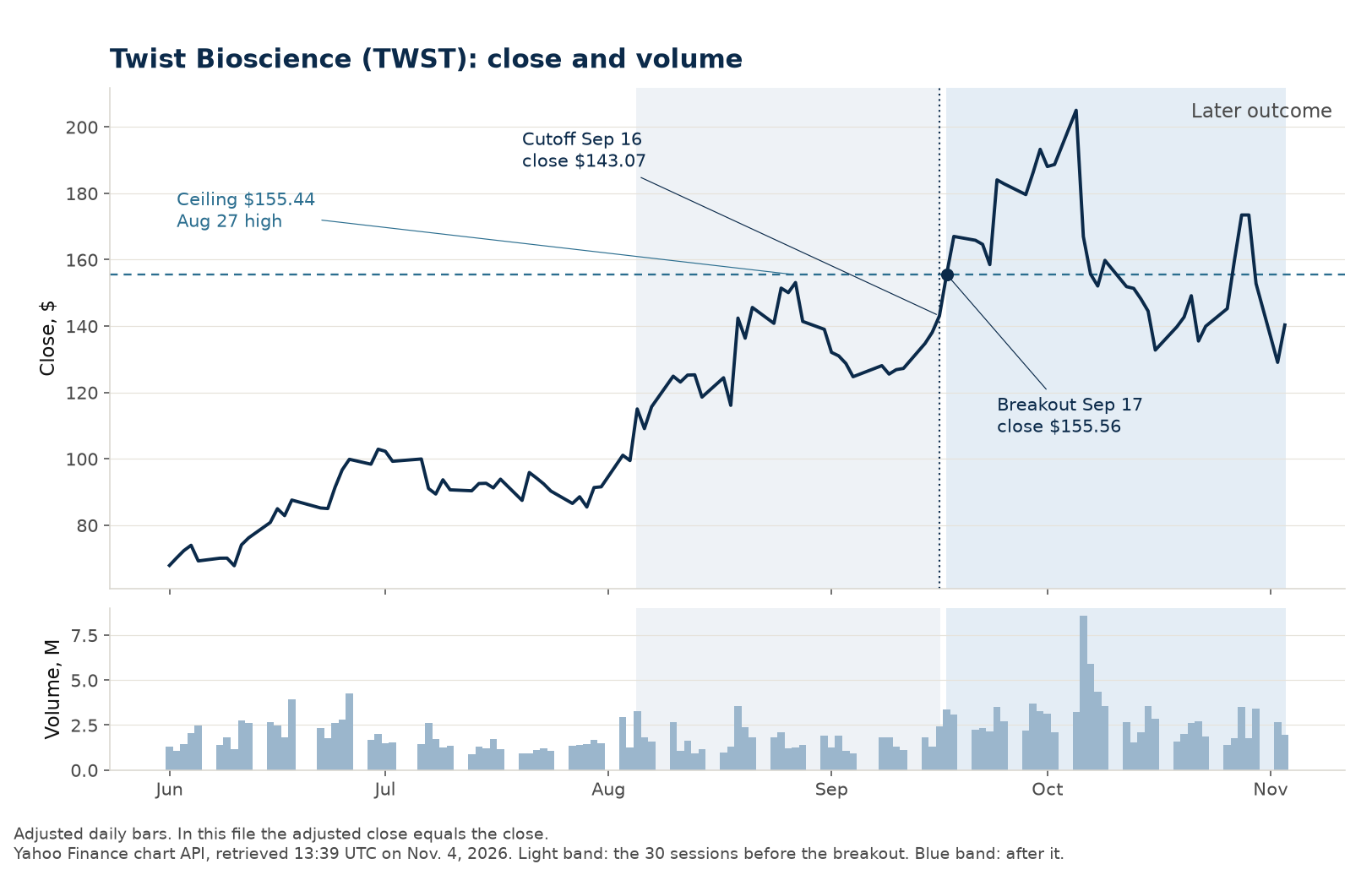
Twist, as of the September 16 close
September 16, 2026 was a Wednesday. The close in this file is $143.07. The high was $148.50 and the low was $137.08, on 2.41 million shares. The 50-session average ending that day is $115.52. The 200-session average is $68.38. The close was above both and $12.37 under the ceiling. The ceiling is $155.44, the August 27 high, 14 sessions earlier. The September 10 low was $120.19. From September 10 to September 16 the closes were $126.85, then $127.22, $134.75, $138.10, and $143.07. The stock was already rising before the September 16 release below.
The fiscal third quarter, ended June 30, had been public since August 3. The 8-K was accepted at 7:21 a.m. Eastern that day. The 10-Q was filed the same day. The August equity deal and the August 18 Anthropic item were also already in the record. I do not treat any of them as news on September 17.
| Item on the September 16 record | Figure | Where it sits |
|---|---|---|
| September 16 close, this file | $143.07 | Last print before September 17 |
| Shares outstanding, July 29 | 62,707,424 | 10-Q cover, filed August 3 |
| Equity value on that count | $8,971.6 million | $143.07 times 62,707,424 |
| Shares if the August deal's 3,593,750 shares were out | 66,301,174 | July 29 count plus the deal |
| Equity value on that higher count | $9,485.7 million | Same close |
| Cash and short-term investments, June 30 | $166.8 million | $117.4 million plus $49.4 million |
| Restricted cash inside the cash-flow total | $2.1 million | Not part of the $166.8 million |
| Quarter revenue | $118.4 million | Up from $96.1 million |
| Quarter net loss | $35.1 million, $(0.56) a share | Prior-year quarter included a $48.8 million gain |
| Adjusted EBITDA, company's non-GAAP figure | $(11.3) million | Reconciled in the release |
| Fiscal 2026 revenue range, August 3 | $456 million to $457 million | Prior range was $442 million to $447 million |
The two equity values are both arithmetic. They differ by whether the August shares are counted. The August 5 8-K says Twist agreed on August 4 to issue 3,125,000 shares at $96.00, that the underwriters exercised the option for all 468,750 additional shares on August 5, and that net proceeds including that option were expected to be about $327.1 million. Closing was expected on or about August 6. I do not find a later filing, as of the September 16 cutoff, that says the closing happened or that it did not. A firm underwriting can close without a second 8-K. Silence is not a failed close. It is also not a confirmation. The prospectus supplement bases its share math on 62,674,150 shares outstanding at June 30, which is 33,274 below the July 29 cover count. I use the later cover count, and I show the offering shares as a separate case.
That prospectus also lists, and excludes from the outstanding count, 997,499 option shares at a $33.15 weighted-average exercise price, 2,602,711 shares under restricted stock units, and 2,394,498 shares under performance-based restricted stock units, all as of June 30. Those are not shares outstanding. I am not adding them into the equity value.
On the company's $456 million to $457 million full-year revenue range, the midpoint is $456.5 million. The July 29 share count at the September 16 close is 19.7 times that midpoint. The count that includes the 3,593,750 offering shares is 20.8 times it. That is division. It is not a view about whether the range is met. Nine-month revenue was already $332.8 million, so the full-year range implies a fourth quarter in line with the company's own fourth-quarter range of $123 million to $124 million. Gross margin in the June quarter was 52.8%, on $118.376 million of revenue and $55.922 million of cost of revenue. The full-year margin line in the release is "above 52%." Adjusted EBITDA breakeven for the fourth quarter is guidance. The release says a reconciliation of that forward figure to GAAP net loss is not available, because the company does not guide the GAAP loss and cannot estimate stock-based compensation without unreasonable effort.
Cash at June 30 is the balance-sheet pair: $117.436 million of cash and equivalents and $49.403 million of short-term investments, $166.839 million, which the release rounds to about $167 million. The cash-flow total of cash, equivalents, and restricted cash is $119.6 million. The difference is about $2.1 million of restricted cash, and it is outside the $166.8 million. There is also a $15 million liability tied to a sale of future revenue. Net cash used in operations for the nine months ended June 30 was $41.3 million. The company says its cash, short-term investments, and expected operating cash flow cover more than 12 months from the date of the 10-Q. That sentence is dated August 3, and it is written before the August offering's expected proceeds.
The shelf was already open. On June 18 Twist filed an automatic shelf, Form S-3ASR, as a well-known seasoned issuer, file 333-296897. The same day it put up an at-the-market program for up to $200 million of gross sales through TD Securities, commission up to 3%, with no obligation to issue any shares under it. The 10-Q repeats that program. I do not find a report of ATM sales between June 18 and September 16. Absence of a sales report in that window is not proof that none occurred. The August underwritten deal is a separate document.
The September 16 company release is a services agreement, not a financial result. Twist said it would provide antibody characterization data for Lilly TuneLab, including for AbLab, an antibody developability model. TuneLab users would be able to order Twist antibody services on TuneLab protocols. The chief executive's quotation mentions preferred pricing. The release states no upfront amount, no milestone, and no royalty. It is datelined September 16, 2026, Business Wire. I do not have a clock time. No Form 8-K with a September 16 or September 17 filing date is in the EDGAR submissions list I pulled on November 4. The September 16 close, $143.07, did not clear $155.44.
One earlier item is easy to mis-time. On August 18, after the close, Twist furnished an 8-K saying Anthropic had named it as an independent evaluator for an AI protein-design campaign. The next session, August 19, closed at $142.39, up from $116.10. That session is inside the September 16 record. It is not the September 17 signal. The ceiling it pushed through was only a few sessions old, so the rule does not call August 19 a base breakout.
What lines up, and what does not
AbCellera's August 10 bar and the Phase 2 release are the same morning. The 8-K was accepted at 7:49 a.m. Eastern. The call was set for 7:30 a.m. Eastern. The release says the data would be out before the open. In this file the open is $8.76, already above the $8.44 ceiling and above the $6.93 prior close. The high is $10.01. The close is $9.34. Volume is 46.0 million shares, 9.2 times the prior 20-session average of 5.0 million. The next closes in the file are $9.76, $10.35, $10.97, and $11.38. None of the next ten closes is under $8.44.
The release says 92 postmenopausal women, randomized one to one, a single 600 mg subcutaneous dose against placebo, and a baseline of about 10 moderate or severe hot flashes a day. At week 4 the mean reduction in frequency was 8.8 events a day on drug and 3.5 on placebo, a placebo-adjusted difference of 5.3, p<0.001. The mean percent reduction was 83% versus 33%. Severity fell 1.4 points versus 0.3, a placebo-adjusted difference of 1.1, p<0.001, or 58% versus 12%. The release says there were no serious adverse events, no severe adverse events, and no discontinuations for adverse events. Headache, fatigue, and injection-site reaction were the events it lists as more common on drug than on placebo. The furnished presentation uses a July 30, 2026 data cutoff. That date does not make the results public on July 30. They were public on the morning of August 10. The company calls the frequency and severity reductions best-in-class. The same materials say no head-to-head trial has been run, and that cross-trial comparisons are limited. I am using the company's words for the company's claim.
The date of the release had been public since 4:43 p.m. Eastern on August 7. A daily bar cannot separate people trading the schedule from people trading the numbers. I do not have a premarket tape. The alignment is real: a before-the-open clinical release, a gap through a high that had stood for 24 sessions, and volume about nine times recent trading. Alignment is not a measurement of how much of the gap was the data.
Twist is a different shape. September 17 opened at $151.43, under the $155.44 ceiling, traded to $163.70, and closed at $155.56. That close is $0.12 above the ceiling. Volume was 3.37 million shares, 1.98 times the prior 20-session average. The next close is $166.99. The next ten closes stay at or above $155.44, which is why the rule calls the signal sustained. The Lilly release was already dated the day before, and the stock had been rising since September 10. I found no September 17 company filing. A twelve-cent close over an old high, the session after a services release that states no dollars, is a weak place to hang a cause. The rule dates the cross. It does not identify who was trading or why.
An AbCellera session on September 17 also closed above a 30-session high, $12.73 against $12.58, on 1.62 times volume. It fails the ten-session test. It is not the signal in this note.
Postscript: the path after the cutoffs
| Date | What the file or the filing shows |
|---|---|
| Aug. 10 | ABCL close $9.34, high $10.01, 46.0 million shares. Phase 2 release accepted 7:49 a.m. Eastern. |
| Aug. 12–13 | ABCL underwriting agreement: 17,435,897 shares at $9.75, and pre-funded warrants for 3,076,926 shares at $9.74999. Net proceeds about $187.0 million. Closing expected on or about August 14. 8-K filed August 13. |
| Aug. 27 | TWST high $155.44, the ceiling the September 17 close later cleared. |
| Sep. 17 | TWST close $155.56, high $163.70. First close over that ceiling on the rule above. |
| Sep. 29 | ABCL peak close in this file, $14.82. The September 30 high is $15.02. |
| Oct. 5 | TWST peak close in this file, $205.00. |
| Oct. 6 | TWST high $219.71, close $166.97, 8.56 million shares. No company 8-K that day in the submissions list. |
| Oct. 8 | TWST close $152.05, the first close back under $155.44. |
| Nov. 2 | TWST lowest close after September 17 in this file, $129.04. |
| Nov. 3 | Last session in the file. ABCL $12.18. TWST $140.30. |
AbCellera's November 3 close is $12.18. That is 75.8% above the August 7 close of $6.93 and 30.4% above the August 10 close of $9.34. No close in this file after August 10 is under the $8.44 ceiling. The August 12 offering was not knowable on August 7. The counts and the $9.75 price imply about $200.0 million before fees. The 8-K's net figure is about $187.0 million. Closing is the word "expected," on or about August 14. I do not have a later document in this note that confirms the close. The shares were to be sold off an automatic shelf, file 333-285367, which the 8-K says was filed February 27, 2025. The shelf's existence predates the cutoff. The priced deal does not.
Twist's November 3 close is $140.30. That is below the September 16 close of $143.07 and below the September 17 close of $155.56. The October 5 close of $205.00 and the October 6 high of $219.71 are in the file, and so is the give-back. The ten-session test had already been satisfied before October 8. The rule's word "sustained" means those ten sessions. It does not mean the stock was still above the ceiling on November 3.
I am not assigning a cause to the October 6 reversal. The submissions list shows Form 4 filings around those dates and no 8-K on October 6. A large range and a headline volume bar are a description of the tape. They are not an explanation.
Sources are the EDGAR filings and the company release linked through this note, plus the daily file retrieved at 13:39 UTC on November 4, 2026. Figures that are arithmetic are marked as arithmetic. The 36-month and 12-month liquidity lines, the revenue range, and the adjusted-EBITDA line are the companies' statements, not mine.
Disclosure. Biotech Stock Reports, DEALITHIC and the author hold no position in, and have received no compensation from, any company mentioned.
For informational purposes only. Not investment advice, and not an offer or solicitation. Nothing here is a recommendation to buy, sell, or hold any security, and we do not publish price targets. Figures are dated and sourced; they change. Read our full disclaimer.